
Natural soap is a small miracle
- by Barbora Mikulášová
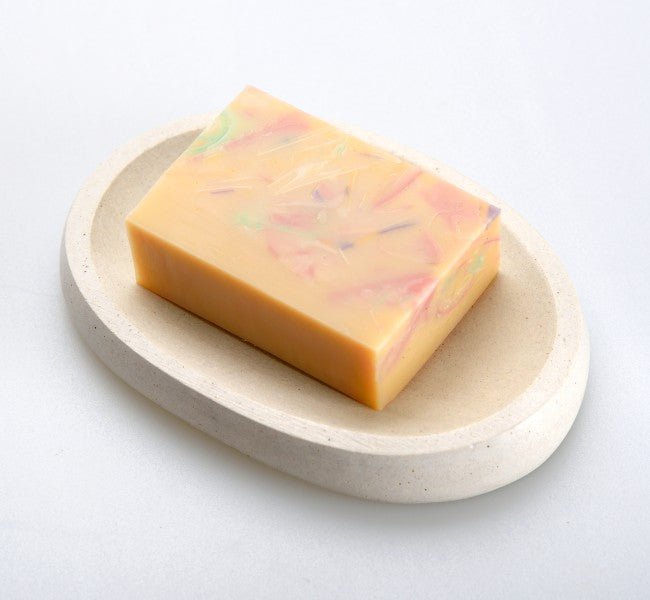
-- 4 minutes of reading --
In our workshop, we organize excursions for schools and kindergartens. At the beginning, I always tell the children about soaps. Everyone claims to have soap at home. Someone liquid, someone solid, everyone knows what we are talking about. But few people know what real soap is made of and how it actually works. And so I tell the children that there are little figures in the soap that have two hands. One long one that catches dirt, impurities, bacteria. And the other short one, which catches the water and thus all the dirt is washed away.
And that's the way it really is. Do you know why?

Everyone who starts making natural soaps probably first learns to make them according to proven recipes from the Internet or from books. At least that's how I did it. I made my first soap at the beginning of 2012 and it was Marseille soap. Why did I choose this, one might say legendary, soap? Because I knew him and I read that he was great. At that time, I knew that it was a gentle vegetable soap, suitable for sensitive skin, as well as for washing or cleaning carpets. Moreover, it is made from available raw materials. Marseille soap is any vegetable fat soap based on olive oil. I still remember this first recipe of mine. It was 75% olive oil and 25% coconut oil. Nothing extra. And guess what, it really worked. At that time, I didn't know what to expect and what was going to happen. It felt like magic as the oils began to change, eventually forming a beautiful pale green soap with a fine lather and large bubbles. We soap makers follow the character of the bubbles quite a bit.
So just two oils were enough to make one of the most famous traditional soaps.
The fact that the soap is made from oils amazes not only children on excursions, but also adults. How can oil form that hard cube that foams, and it is precisely oils and fats that can be washed away? Well, who would have thought it, it's related.
CHEMICAL WINDOW
This is because oil/fat consists of fatty acids. And soap is a salt of a fatty acid.
What does the salt make of the fat? Hydroxide. Sodium or potassium. We use sodium hydroxide in the production of solid soap. Thanks to it, the fat is transformed into soap. The hydroxide is completely consumed, so there is no longer a trace of it in the soap. So if we have a good recipe and the right production process.

Fatty acids are such long fat-soluble chains. During the production of solid soap, sodium binds to them, and sodium salt is formed. It has two ends. One long, fat soluble, that comes from a fatty acid. The second, short one, is attached to the water. And we have the stick figure I wrote about at the beginning.

Due to the long chain, dirt is attached to the soap. The sodium/potassium at the other end in turn binds to water. Not only soap works on this principle, but also other detergents, i.e. substances used for washing.
A byproduct of the saponification reaction is glycerin. The latter remains contained in the handmade soaps, and contributes to the softness and emollient properties of the soap. But it also makes these soaps softer. Glycerin binds water to itself. And even from the air. Do you already know why soaps are sold like crazy in the markets after the rain?
That was a chemical window. Now we know that soap is based on fat and hydroxide. Only this double is enough to create soap.
But which fats to choose for production?
THE MAGIC OF RECIPES
Soap has several charms. Well, at least it seems so to me, a soap enthusiast. One of the magics is that you can create countless different recipes. Soap offers a lot of room for experimentation. You can use practically any fats or oils for its production. Except, for example, mineral oil. It does not contain fatty acids, so it is clear that we will not make soap from it.
Let's start simple. We can easily use only one fat/oil to make soap.
A traditional example of such soap is Castile soap made from 100% olive oil. This proven recipe has been produced for at least 1000 years. The soap is extra soft, very gentle, hard and long-lasting. It has a weaker foam and can be a little gooey to the touch. It is light green, the shade varies depending on the olive oil used. The interesting thing is that it needs to mature for a long time, several months, even a year. It is used for extra sensitive and dry skin, to wash the face, some people also like it for hair. It is also suitable for cleaning delicate materials such as Persian carpets or tadelakt.
Another classic example of a single-ingredient soap is soap made from 100% lard. It is also very gentle and gentle. It is hard and lasts a long time. It has a richer creamy foam. And it's creamy white too. I personally like that it is typically Czech. This soap is suitable for washing the whole body, but it can also be used for cleaning or cleaning.
Just these two fats/oils make great soap on their own. But there are also oils from which we can make one-component soap, but we probably won't be completely satisfied with the result. The soap may not foam or be very soft. So we start thinking that we would rather combine the oils somehow. And that's how it's done in most recipes for natural soaps.
So how do you combine several different oils into soap? Do you want to know how different fats affect the properties of soaps? And how did I learn to create recipes myself?
You will read about this in the next blog.
Image authors:
1) Teodor Mikuláš
2) Author: Avitek on the Czech language Wikipedia project, CC BY-SA 3.0, https://commons.wikimedia.org/w/index.php?curid=6265315
3) Free work, https://commons.wikimedia.org/w/index.php?curid=611988


Buscas una plataforma independiente con resenas honestas de casinos en linea, bonos actualizados y valoraciones de jugadores reales? Visita https://championcasino.world/ el recurso mas grande con la informacion mas actualizada del mundo de las apuestas y resenas de jugadores reales para ayudarte a elegir el casino ideal.
Да, решено.
1хбет букмекерская контора, [url=https://1xbet-gzn0.top/]https://1xbet-gzn0.top/[/url] разрешает множество вариантов для ставок. У пользователей есть опция к широкому спектру мероприятий и выгодным коэффициентам.
Это — заблуждение.
болливуд казино, [url=https://bollywoodplay247.ru/]болливуд казино играть[/url] предлагает уникальный опыт для любителей азартных игр. Гости могут насладиться классными играми и увлечениями. Каждый мгновение полное адреналина и волнения. Погрузитесь в вселенную азартных игр с наивысшим уровнем обслуживания.