
Natural soap is a small miracle
- by Barbora Mikulášová
-- 4 minutes of reading --
In our workshop, we organize excursions for schools and kindergartens. At the beginning, I always tell the children about soaps. Everyone claims to have soap at home. Someone liquid, someone solid, everyone knows what we are talking about. But few people know what real soap is made of and how it actually works. And so I tell the children that there are little figures in the soap that have two hands. One long one that catches dirt, impurities, bacteria. And the other short one, which catches the water and thus all the dirt is washed away.
And that's the way it really is. Do you know why?

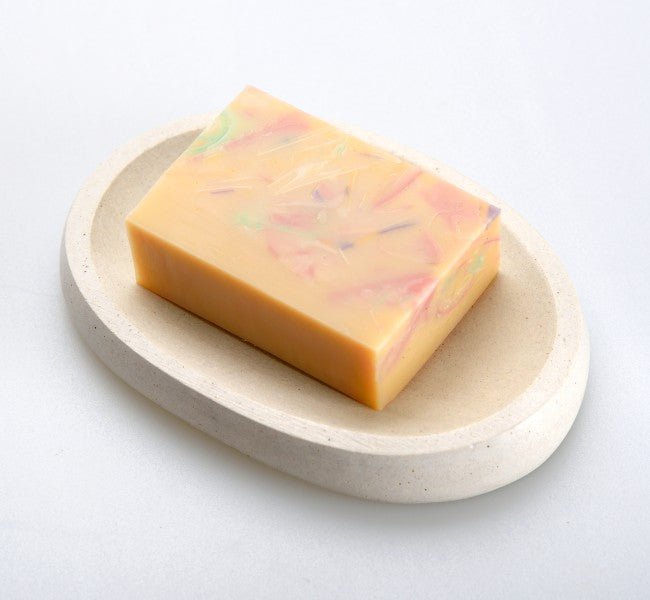
Everyone who starts making natural soaps probably first learns to make them according to proven recipes from the Internet or from books. At least that's how I did it. I made my first soap at the beginning of 2012 and it was Marseille soap. Why did I choose this, one might say legendary, soap? Because I knew him and I read that he was great. At that time, I knew that it was a gentle vegetable soap, suitable for sensitive skin, as well as for washing or cleaning carpets. Moreover, it is made from available raw materials. Marseille soap is any vegetable fat soap based on olive oil. I still remember this first recipe of mine. It was 75% olive oil and 25% coconut oil. Nothing extra. And guess what, it really worked. At that time, I didn't know what to expect and what was going to happen. It felt like magic as the oils began to change, eventually forming a beautiful pale green soap with a fine lather and large bubbles. We soap makers follow the character of the bubbles quite a bit.
So just two oils were enough to make one of the most famous traditional soaps.
The fact that the soap is made from oils amazes not only children on excursions, but also adults. How can oil form that hard cube that foams, and it is precisely oils and fats that can be washed away? Well, who would have thought it, it's related.
CHEMICAL WINDOW
This is because oil/fat consists of fatty acids. And soap is a salt of a fatty acid.
What does the salt make of the fat? Hydroxide. Sodium or potassium. We use sodium hydroxide in the production of solid soap. Thanks to it, the fat is transformed into soap. The hydroxide is completely consumed, so there is no longer a trace of it in the soap. So if we have a good recipe and the right production process.

Fatty acids are such long fat-soluble chains. During the production of solid soap, sodium binds to them, and sodium salt is formed. It has two ends. One long, fat soluble, that comes from a fatty acid. The second, short one, is attached to the water. And we have the stick figure I wrote about at the beginning.

Due to the long chain, dirt is attached to the soap. The sodium/potassium at the other end in turn binds to water. Not only soap works on this principle, but also other detergents, i.e. substances used for washing.
A byproduct of the saponification reaction is glycerin. The latter remains contained in the handmade soaps, and contributes to the softness and emollient properties of the soap. But it also makes these soaps softer. Glycerin binds water to itself. And even from the air. Do you already know why soaps are sold like crazy in the markets after the rain?
That was a chemical window. Now we know that soap is based on fat and hydroxide. Only this double is enough to create soap.
But which fats to choose for production?
THE MAGIC OF RECIPES
Soap has several charms. Well, at least it seems so to me, a soap enthusiast. One of the magics is that you can create countless different recipes. Soap offers a lot of room for experimentation. You can use practically any fats or oils for its production. Except, for example, mineral oil. It does not contain fatty acids, so it is clear that we will not make soap from it.
Let's start simple. We can easily use only one fat/oil to make soap.
A traditional example of such soap is Castile soap made from 100% olive oil. This proven recipe has been produced for at least 1000 years. The soap is extra soft, very gentle, hard and long-lasting. It has a weaker foam and can be a little gooey to the touch. It is light green, the shade varies depending on the olive oil used. The interesting thing is that it needs to mature for a long time, several months, even a year. It is used for extra sensitive and dry skin, to wash the face, some people also like it for hair. It is also suitable for cleaning delicate materials such as Persian carpets or tadelakt.
Another classic example of a single-ingredient soap is soap made from 100% lard. It is also very gentle and gentle. It is hard and lasts a long time. It has a richer creamy foam. And it's creamy white too. I personally like that it is typically Czech. This soap is suitable for washing the whole body, but it can also be used for cleaning or cleaning.
Just these two fats/oils make great soap on their own. But there are also oils from which we can make one-component soap, but we probably won't be completely satisfied with the result. The soap may not foam or be very soft. So we start thinking that we would rather combine the oils somehow. And that's how it's done in most recipes for natural soaps.
So how do you combine several different oils into soap? Do you want to know how different fats affect the properties of soaps? And how did I learn to create recipes myself?
You will read about this in the next blog.
Image authors:
1) Teodor Mikuláš
2) Author: Avitek on the Czech language Wikipedia project, CC BY-SA 3.0, https://commons.wikimedia.org/w/index.php?curid=6265315
3) Free work, https://commons.wikimedia.org/w/index.php?curid=611988


virtual number for otp
폰테크
모바일 폰테크란 스마트폰을 활용해 단기 자금을 마련하는 합법적인 자금 조달 방법입니다. 일반적인 소비 목적의 휴대폰 사용과는 달리 통신 구조와 유통 경로를 이용해 현금을 확보하는 구조를 가지고 있으며, 절차가 비교적 단순하고 접근성이 높다는 장점이 있습니다. 신용 문제로 금융권 이용이 어렵거나 급전이 필요한 상황에서 대안적인 방법으로 활용되는 경우가 많습니다.
휴대폰 테크의 일반적인 절차는 이해하기 어렵지 않습니다. 통신사 정책에 맞춰 휴대폰을 개통한 후, 해당 단말기를 매입 업체를 통해 처분합니다. 가격은 모델과 시장 시세, 조건에 따라 달라지며, 판매 대금은 현금 또는 계좌이체로 지급됩니다. 이후 발생하는 요금과 할부금은 사용자 책임으로 관리해야 하며, 이 부분에 대한 관리가 매우 중요합니다. 해당 방식은 불법 금융과는 다르며, 기기를 자산화하는 개념으로 이해할 수 있습니다.
기존 금융권 대출과 비교하면 뚜렷한 차이가 있습니다. 신용 심사나 서류 제출 부담이 적고, 비교적 빠르게 현금을 확보할 수 있다는 점이 가장 큰 특징입니다. 금융 이력이 남지 않기 때문에 신용도에 부담을 느끼는 경우에도 접근이 가능합니다. 하지만 통신요금 미납이나 연체가 발생할 경우 신용도에 영향을 줄 수 있으므로 신중한 관리가 반드시 필요합니다.
사람들이 폰테크를 선택하는 이유는 다양합니다. 급전이 필요한 상황이나 금융 이용이 제한된 경우, 자금 흐름이 필요한 상황 등 다양한 상황에서 고려됩니다. 즉각적인 현금 흐름이 중요한 경우에 실질적인 선택지로 평가됩니다.
확보한 현금은 주식이나 코인 투자, 사업 자금, 생활비 등 여러 방식으로 활용될 수 있습니다. 다만 자금 사용에 대한 책임은 모두 본인에게 있으며, 모든 투자에는 리스크가 따른다는 점을 충분히 인지해야 합니다. 폰테크는 수익을 보장하는 수단이 아니라 단순한 자금 마련 방법이라는 점을 이해해야 합니다.
폰테크는 합법적인 구조이지만 주의해야 할 부분도 분명히 존재합니다. 과도한 휴대폰 개통은 통신사 제재의 대상이 될 수 있으며, 상환 계획 없는 이용은 오히려 리스크가 됩니다. 또한 고수익을 보장하거나 명의 대여를 요구하는 업체는 피해야 하며, 모든 과정은 반드시 본인 명의로 정상 진행되어야 합니다.
정리하자면, 해당 방식은 통신 구조를 이용한 정상적인 자금 마련 수단으로, 올바른 정보와 신중한 판단이 전제된다면 단기 자금 확보에 도움이 될 수 있습니다. 무엇보다 사전 정보 확인과 신중한 선택이 가장 중요합니다.